

Virtual Reality Development Trends: From Impressive Demos to Repeatable Use
A virtual reality demonstration can succeed in five minutes and still leave an organisation unsure what to do next. The participant enjoys it, the visual quality attracts attention and the equipment appears capable. Yet the business questions remain: who will use it regularly, what should they achieve and how will the experience be maintained?
For organisations commissioning custom VR, those questions offer a useful way to interpret current developments. New capabilities matter when they make an experience easier to deliver, more appropriate for the task or more dependable across repeated sessions. Novelty alone is a weak basis for a long-term programme.
Developments in standards, interaction and production are expanding the choices available to developers. This article considers their practical implications for training, education and events. It is an assessment of what buyers should examine, rather than a prediction that every organisation will adopt the same hardware or application model.
Open standards are changing the portability conversation
The Khronos OpenXR registry maintains a shared interface for XR applications and runtimes. Its continuing development is relevant to buyers because device-specific work can affect the effort required to maintain an application across different environments.
The OpenXR changelog records further spatial and interaction-related extensions during 2026. These are developments in the specification, not proof that every headset supports every capability. Runtime availability and the application's implementation still determine what works on a particular device.
The commercial implication is a more precise portability discussion. Ask which parts of an application use common interfaces and which depend on platform-specific features. A shared technical foundation can reduce some adaptation work, but performance, input behaviour and distribution still need testing. A promise that one build will work everywhere is less useful than a documented support plan for the devices your organisation actually intends to use.
The unit of value is a repeatable task
A compelling VR project gives the participant something meaningful to do. That might be identifying a component, rehearsing a conversation or exploring the consequences of a decision. The environment creates context, but the activity creates the reason to return.
Consider an illustrative training scenario involving a virtual equipment inspection. A participant examines a simulated assembly, identifies an abnormal condition and selects an appropriate response. The useful design question is whether the experience allows the learner to practise the intended judgement, receive relevant feedback and attempt it again.
This changes the brief. Instead of specifying only the room, objects and visual style, the organisation describes the decisions that matter. Developers can then design interactions around those decisions. Realistic scenery may help, but its value should be assessed against the task. An elaborate environment with little meaningful interaction can become an expensive backdrop to a conventional presentation.
Interaction choice is becoming a design decision
Hands, controllers and gaze-based selection offer different possibilities. None is automatically the most intuitive input for every audience or activity. A user may understand how to reach towards a virtual object but still need guidance about selecting, releasing or confirming an action.
Controller input can provide deliberate triggers and physical reference points. Hand interaction can remove the need to explain a handheld device, but visibility, posture and tracking conditions must be considered. A good project treats input as part of the learning or service experience, rather than as a feature chosen because it looks impressive in a promotional video.
For buyers, this means evaluating the complete task with representative participants. Can a first-time user complete it without continuous coaching? Can the experience distinguish exploration from a consequential selection? Are repeated gestures comfortable? These are more useful questions than whether a demonstration includes the newest interaction method. The chosen input must support the activity reliably on the agreed hardware.
First-time use deserves its own design
An experienced developer can forget how unfamiliar a headset feels to someone using it for the first time. The participant must understand how to begin, what they can interact with and how to stop. Uncertainty at this stage can obscure the value of an otherwise well-designed application.
A short practice interaction can help establish the relationship between movement and response. For example, a learner might select a large virtual object and place it in an obvious destination before starting the main activity. The purpose is to build confidence in the controls, not to test the learner's subject knowledge prematurely.
This is particularly relevant to events, where a facilitator has limited time with each participant. An application that depends on a lengthy spoken explanation may be difficult to operate in a busy environment. The introduction, reset process and handover between users deserve as much attention as the most visually impressive scene.
Mixed reality expands options, but suitability still matters
The ability to combine digital content with a view of the surrounding room introduces another design option. It can be useful when awareness of physical context is part of the task. Fully immersive VR remains appropriate where a simulated environment needs to control the participant's attention.
These approaches should not be treated as interchangeable labels. A training activity set in a simulated location may need a coherent virtual world. A spatial demonstration tied to an actual room may benefit from keeping the room visible. The decision should follow the learning or communication objective and the supported capabilities of the selected device.
A proposal should explain why its chosen presentation mode helps the user. It should also identify what happens if a relevant capability is unavailable or unsuitable at the deployment location. That discussion is more valuable than adding mixed reality to a scope merely because the platform makes it possible.
Content architecture influences the useful life of the application
A VR application can become difficult to maintain when every change requires editing the entire experience. Product information, scenario instructions and assessment rules may evolve at different rates. Treating all of them as permanently fixed can turn routine updates into substantial development work.
One practical response is to distinguish stable interactions from content that is expected to change. This does not require making every element editable by the client. It means deciding deliberately which updates need developer review and which can be managed through a controlled content process.
For example, a training programme may retain its core equipment interaction while introducing new scenarios. The value lies in reusing an appropriate foundation without pretending that a new scenario needs no testing. Changes to the task, scoring or sequence can affect the experience even when the environment remains familiar. Maintainability is therefore both a technical and an editorial concern.
Measurement needs an interpretation, not just a dashboard
VR applications can record events such as selections, completion and attempts. Those records become useful only when they answer a meaningful question. Completion might mean a participant reached the final screen, but it does not necessarily establish understanding or transfer to real work.
A training buyer should agree what the application is intended to assess and what requires observation elsewhere. An event team may care about participation and subsequent interest rather than learning outcomes. An education provider may need to distinguish confident performance from repeated guessing.
This is a reason to define measurement before production, not to promise that every result can be quantified. Collecting more events can add complexity without improving decisions. A small number of well-defined signals, combined with participant and facilitator feedback, may provide a clearer basis for improvement. Reporting should state the limits of what the experience actually observed.
Deployment is part of the experience
A headset application has an operational life beyond its launch build. Devices need preparation, applications need reliable starting behaviour and sessions need a predictable reset. Someone must know which version is installed and what to do when the expected experience does not begin.
For an event, the critical constraint may be throughput. For a training room, it may be repeatable access across scheduled sessions. For a distributed programme, support and update arrangements may dominate. These contexts call for different deployment choices even when the underlying VR activity is similar.
The practical lesson is to test the whole session, from equipment preparation to the next participant's start. A strong demonstration on a developer's headset does not establish readiness for several devices in another venue. Operational testing makes hidden dependencies visible while there is still time to address them in the project scope.
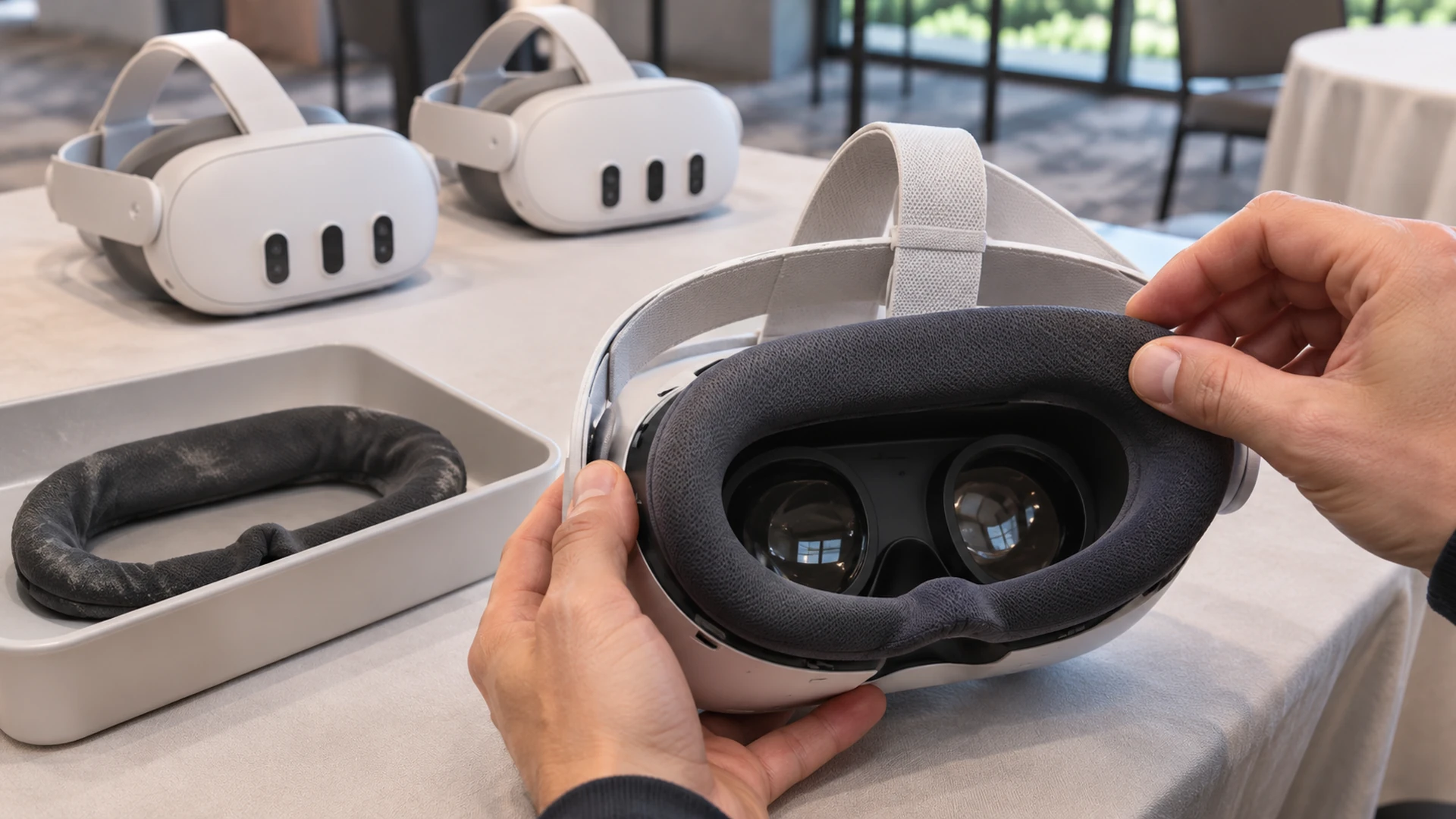
Realism should serve the judgement being practised
Visual fidelity is easiest to justify when it helps users notice something relevant. The shape of a component, the position of a control or the relationship between objects may matter directly to the task. Other details may contribute atmosphere without improving the intended outcome.
This distinction affects performance and production cost. A project can spend heavily on visual complexity while leaving important feedback unclear. Conversely, excessive simplification can remove the cues a participant needs to make a meaningful decision. The right level of detail depends on what the experience asks the user to recognise or do.
A useful review therefore asks which visual elements are essential evidence and which are optional decoration. That gives the team a principled way to make trade-offs. The objective is not maximum realism in every direction, but enough relevant detail to support a convincing and usable experience on the target hardware.
The next phase needs clearer ownership
As VR moves beyond a one-off demonstration within an organisation, ownership becomes more important. Who approves changes to the scenario? Who checks that the content remains accurate? Who supports facilitators and decides when equipment or software needs review?
These responsibilities do not have to sit with one person, but they should be explicit. Otherwise a technically functional application can become operationally neglected. A project may lose usefulness because its instructions or deployment assumptions no longer match the organisation, even while the original software still runs.
Buyers should regard handover material and an agreed maintenance arrangement as part of the deliverable. This gives the application a route to remain useful as content and circumstances change. It also helps distinguish a deliberately limited campaign experience from a programme expected to support repeated use over a longer period.
What these developments mean for a new project
The most useful response to VR industry change is selective adoption. Start with a task worth practising or an experience worth delivering, then evaluate the technology against that purpose. Standards, interaction methods and visual tools should support that decision rather than replace it.
360 Design's virtual reality development service provides a starting point for discussing a custom application. A productive brief identifies the audience, the intended activity and the environment in which sessions will run. It also leaves room to test assumptions before committing to the full experience.
To explore a project, contact 360 Design with the decision or activity your users need to experience. A successful VR investment should be explainable after the excitement of the first demonstration: it gives the right people a useful experience they can access, understand and repeat.
Gerald Ferreira
Founder and Digital Pioneer at 360Design.org. Leading groundbreaking innovations across Web Development, Virtual Reality, Augmented Reality, 3D Renders, and AI since 1998.


